
STRIPS Copywriting Framework: How To Turn Facts Into Sales
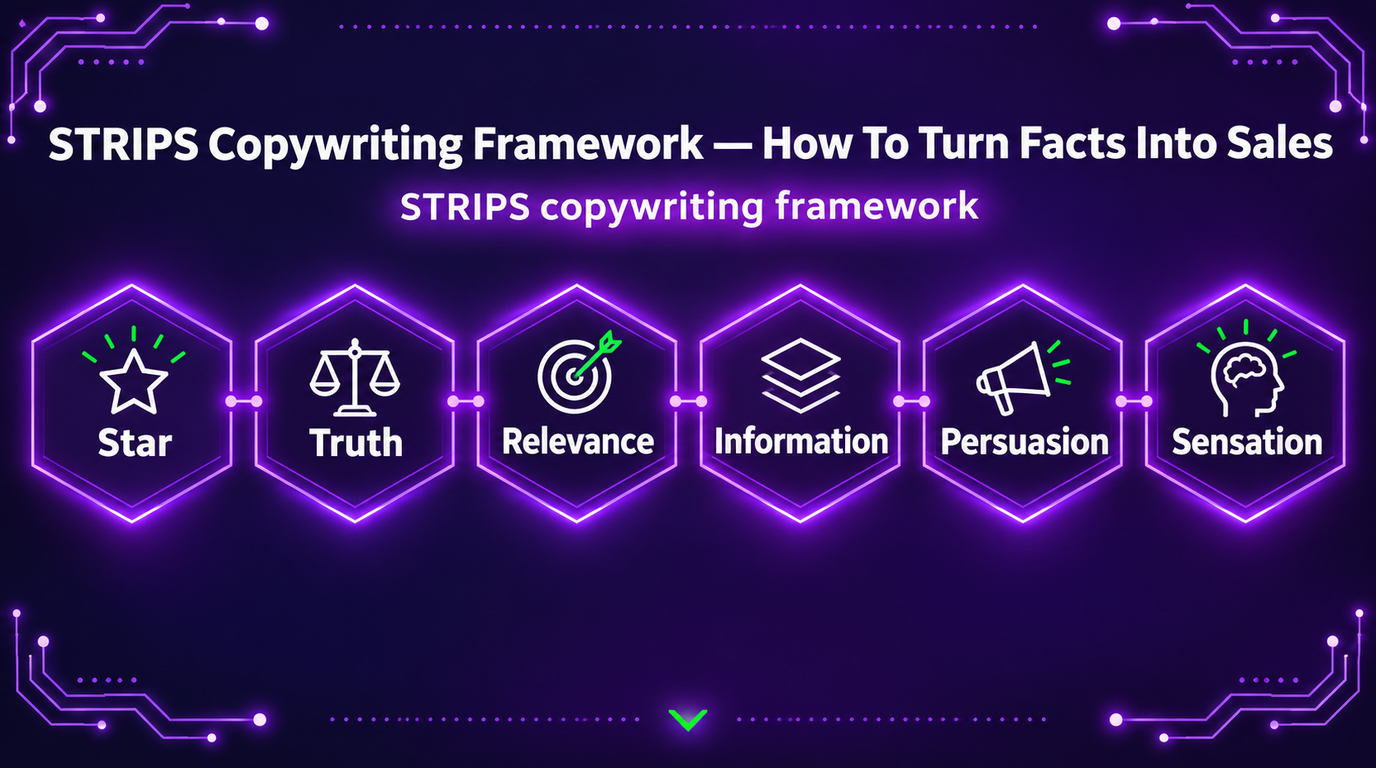
Most copy fails because it lists. The STRIPS copywriting framework is how you turn the same facts into an offer someone actually responds to.
1. Star: Hook The Reader With The Situation They Are Already In
Clayton Makepeace used to say that the first line of a sales letter is worth more than the first thousand dollars of the rest of it. He meant it literally. Before you describe your product, you describe the reader's world, and you do it in language they recognise instantly as their own.
The Star stage is not a headline. It is a situation, and a specific one. The test is simple: can you write a Star paragraph that would fit half the sales letters ever written? If yes, it is too wide. Straps, watchmakers, cameras, fountain pens, the classic direct mail industries, all have the same tired opening. Sharp enough to be noticed, specific enough to be believed.
Here is the difference:
- Weak Star: "In a world of ever-increasing complexity, consumers need better solutions."
- Strong Star: "You have bought three mechanical keyboards. Two of them are in a drawer somewhere, and the third is the one you reach for at midnight. The difference is the weight, and you know it the moment your fingers land on it."
The second one costs a keyboard maker nothing to verify and makes the reader feel seen. It also creates the gap: if the third keyboard was the one that worked, why not this one?
Makepeace's rule was to name the reader's existing workaround. People who already bought three, or already carry two, or already own the cheap version, are not leads. They are readers with a problem the market has failed to solve, and they are the warmest audience you can buy.
Watch for the trap of naming a desire instead of a situation. "You want to look sharp" is a wish. "You are standing at a counter at 7am with a colleague you would rather not see" is a scene. Copy sells to scenes.
2. Truth: Give The Reader A Reason To Believe You
Once the reader knows who you are writing to, you prove that you know what you are talking about. The Truth stage is credibility, but Makepeace was blunt about the order of operations: truth comes before relevance, and relevance comes before information. Nobody wants your facts. They want a reason to keep reading.
There are three kinds of proof, and you should use all three in most letters:
- Third-party proof: a customer, a publication, an analyst, a returning buyer. "Two thousand watchmakers have switched since 2019."
- First-hand proof: your own experience making the thing. "We spent eleven months on the escapement."
- Inherent proof: what the product is made of, how it is made, why the material cannot be faked. This is the strongest of the three because the reader can check it with their own eyes.
Write Truth in a single tight paragraph. Makepeace kept it to a few sentences because every sentence that is not credibility is a sentence the reader is spending attention on for free. You have not earned the right to talk about features yet.
Annotated copy, the way he would have laid it out:
"We have been building chronographs in Besançon since 1974. Every movement we ship is regulated in five positions at 0 seconds, and every case is finished by hand, which is why no two dials catch light quite the same way."
Why it works: the date and the city place you in a real workshop with a real history. The five-position regulation is a specification the reader can imagine being tested. The hand-finishing sentence is the payoff, and it lands on a benefit nobody can copy without doing the same work.
Do not stack the credibility. One strong fact beats four weak ones, and a paragraph that lists certifications reads like a spec sheet nobody asked for.
3. Relevance: Connect The Truth To The Reader's Life
This is where most copy falls apart. Writers establish credibility beautifully and then pivot into catalogue copy, because they think relevance means listing features. It does not. Relevance means the truth has to land on something the reader already wanted.
Ask yourself: what did the reader say yes to in the Star paragraph? If they said yes to "the one you reach for at midnight", then relevance means connecting the movement's accuracy to the feeling of using a tool that works when you are tired.
Makepeace's phrasing for this is useful. Relevance is where you take the truth you have already established and put it into the reader's hands. A 40mm chronograph with a vertical clutch is not a fact. A 40mm chronograph with a vertical clutch means you can set the stopwatch while the needle is running, which means you can time a swim without breaking stride.
Here is the structural point that trips up most writers: the number of truths and the number of relevances should roughly match. If you have established three credible facts, you owe three relevance sentences. A truth with no relevance is a feature. A relevance with no truth behind it is a promise you cannot keep, and readers can smell that from across the page.
Write it as a pair, line by line:
- "The case is milled from a single block of 316L steel, so the seams do not catch your shirt sleeve."
- "The bracelet has no rivets, because rivets are the first thing to loosen on a watch that spends its life on a wrist."
Both of those do two jobs. They are true, and they are about a moment the reader will actually have.
4. Information: The Facts, Sorted By How Much They Matter
Only now do you get to the features. That order is not politeness. If you drop specifications early, the reader has no frame for judging them, so they read them as noise. By the time you reach Information, the reader already knows what kind of person you are and why their problem is worth solving. Now the details have somewhere to sit.
Makepeace's instruction was to rank features by importance and then write them in that order, ruthlessly. The most important feature gets the most words. The least important feature gets one clause, or gets cut entirely.
A useful way to sort: ask what the reader would complain about if it were missing. That complaint is your order of operations. Nobody has ever returned a watch because the box had a velvet lining. People have returned watches because the crown was stiff, or because the lume faded, or because the strap scratched their wrist.
Write the information as flowing prose, not bullets, in direct mail and in long-form landing pages alike. Makepeace hated bullet lists in body copy because they break the rhythm of a persuasive paragraph. A list says here are some things. Prose says here is why this matters.
"The lume is a proprietary compound applied by hand in three coats, and the middle coat is what carries the charge. This is why the glow on these hands lasts until 4am and the cheap ones are dark by 11."
That is information. It is also very nearly persuasion, which is fine, because the last stage is where you make the ask.
5. Persuasion: Make The Offer Inseparable From The Product
Persuasion is the stage writers are most afraid of, because it sounds like pressure. Makepeace's version is closer to arithmetic. You restate the truth, the relevance, and the information in a single sequence that ends with an offer, and you make it feel like the natural conclusion of everything you have said so far.
The bridge is where the STRIPS copywriting framework earns or loses the sale. If your offer arrives as a change of subject, it reads as a stranger asking for money. If it arrives as the answer to the problem you named in the Star, it reads as inevitable.
Try this sequence:
- Recap the situation from the Star, in one line.
- Recap the truth in one line.
- Restate the two or three relevances.
- Give the price.
- Give the reason the price is what it is.
- Give the risk reversal, if you have one.
- Give the deadline, if it is real.
Annotated:
"You need one watch that behaves like a tool and dresses like a watch, built by people who have been doing it for fifty years, with a movement you can time and a case that will not scratch you. That is 2,400 pounds. It is 2,400 pounds because the movement is regulated by hand, the case is milled from one block, and there are 340 of these a year. If it is not right, send it back within 60 days, no argument. The 2019 model will be gone by December."
Every sentence in that block traces back to something earlier in the letter. Nothing new is introduced at the point of sale, which is exactly why it feels like a conclusion rather than a pitch.
Two warnings. Never manufacture a deadline; a fake scarcity claim is the fastest way to lose trust you spent six stages building. And never drop the risk reversal. Makepeace priced risk reversal into his offers as a matter of course, because the objection he heard most was not about price but about being wrong.
6. Sensation: Leave The Reader Holding The Object
The final stage is the one almost nobody writes, and it is the reason people remember the letter. Sensation means you end on the physical experience of the product, not on the transaction. The buyer's finger is on the button, and you hand them a picture of Tuesday evening with the thing in their hand.
Makepeace wanted the reader to finish the last paragraph feeling they had already used the product. It is a closing image, and it has to be consistent with everything before it. If your facts were about precision and quiet operation, the image had better be a quiet room.
"It arrives in a wooden box that you will keep, and the first thing you will do is wind it. The crown is smooth, the click is small, and after a week you will stop noticing it, which is the point. It is 4am, the lume is still holding, and you can read the time without thinking about it."
Notice what that does. It contains no new claim. It contains no new price. It simply finishes the story the reader has been inside since the first paragraph.
A practical constraint: put the Sensation paragraph after the offer has been made, or fold the two together, but never use it to hide the ask. The reader should know exactly what happens next. Sensation is the last impression, not the reprieve from the decision.
7. The STRIPS Framework Compared To The Frameworks You Already Know
| Framework | Core question | Best used for | Weakest point |
|---|---|---|---|
| STRIPS | How do I make a fact matter? | Direct mail, long sales pages, catalogue copy | Sensation stage gets skipped |
| AIDA | How do I get attention and hold it? | Ad copy and landing pages | Interest is thin |
| PAS | What is the reader's problem? | Email sequences, cold outreach | Solution arrives too early |
| FAB | What does the feature do? | Product descriptions, spec-led pages | Benefit never gets specific |
| BAB | What happens after they buy? | Upsells, email follow-up | No place for proof |
The difference in the rows is instructive. AIDA is about attention. PAS is about agitation. FAB is about feature mechanics. STRIPS is the only one of the five with an explicit credibility stage, which is why it was the framework that direct mail writers leaned on when the letter had to carry a price.
Where the frameworks are complementary: the AIDA copywriting framework handles the first two paragraphs of the Star, and the FAB framework is a clean way to generate your Information and Relevance pairs.
8. Worked Example: One Product, Six Stages
Here is the same product through all six stages, compressed. A stainless steel travel mug that keeps coffee hot for twelve hours. Nothing exotic, which is the point.
Star: "You have bought four travel mugs. Three of them leak into the bag, and the fourth keeps your coffee lukewarm by 10am."
Truth: "We machine the body from a single piece of 18/8 stainless and press the lid on with a silicone gasket that we make ourselves."
Relevance: "A single piece means no seam inside the body for coffee to hide in. A gasket we control means the seal fits the thread, not the other way round."
Information: "Double-walled and vacuum-sealed, 340 grams, dishwasher safe, and the lid opens with one hand, which matters when you are holding a train ticket."
Persuasion: "Twelve hours of heat and twenty-four of cold, in a mug that costs 42 pounds, because the wall is machine not moulded and the gasket is replaceable rather than glued. Send it back in 60 days if it leaks. We have 800 left in this batch."
Sensation: "You pick it up at 6:40am and the coffee is still hot at a quarter past six in the evening, and the bag stays dry, and you stop thinking about the mug entirely, which is the nicest possible outcome."
Count the sentence budget. Roughly 120 words for the first four stages, 90 for the offer, 45 for the image. That ratio is close to what Makepeace used, and it holds for a 300-word direct mail letter as well as a 3,000-word landing page.
9. Six Mistakes That Break The STRIPS Sequence
- Starting with the product. If the first thing the reader sees is your product name, you have lost the Star stage and everything after it.
- Truth without relevance. Credibility that does not connect to the reader's situation is a brochure.
- Features before proof. Nobody can value a specification they have no reason to trust.
- Stating the price with no reason attached. A price without a reason reads as arbitrary, and arbitrary prices get compared.
- Invented scarcity. "Only 3 left" when there are 3,000 is the single fastest way to destroy a truthful letter.
- Ending on logistics. If your last line is the returns address, you have thrown away the Sensation stage for nothing.
There is a seventh habit worth naming, because it is the one Makepeace hammered hardest in his own work: write the Star paragraph last. Draft the letter from the persuasion stage backwards. Start with the offer, then work out what has to be true for that offer to make sense, then go and find the truth that supports it. The letter gets easier to write and considerably harder to argue with.
10. Where To Put This To Work This Week
Take the longest sales page on your site and run it through the six stages in order. Number each paragraph in the margin. Most pages you will find: Star present, Truth buried at paragraph nine, Relevance missing entirely, Information in a table, Persuasion at the bottom, and a hard stop at a shipping policy. That is a page built by someone who has never been taught that facts need a frame.
One exercise is enough. Take a single product, write one paragraph for each stage, keep them under 60 words, and put them in order. You will find the offer suddenly feels like a conclusion rather than an interruption, and that is most of what the STRIPS copywriting framework is for.
Then, if you want the paid versions: the pricing on our plans page covers volume, or read the PAS framework for the problem stage in more depth.
You've read the part most people skip.
Get the 3 frameworks that make this land in your inbox - every Thursday. One email a week. Unsubscribe in one click.
Enjoyed this article?
Try Advertorial Wizard to create high-converting copy.