
The SCQA Copywriting Framework: How McKinsey's Storytelling Structure Converts High-Ticket B2B Buyers
The SCQA Copywriting Framework: How McKinsey's Storytelling Structure Converts High-Ticket B2B Buyers
Most copywriting frameworks were built for consumer impulse buys. AIDA was designed to sell soap and cigarettes. PAS thrives on emotional agitation. But what happens when your buyer is a CFO reviewing a $50,000 SaaS contract, or a marketing director evaluating an agency retainer?
That's where the SCQA framework earns its place. Developed inside McKinsey & Company and refined over decades of high-stakes executive communication, SCQA gives you a structure that respects your buyer's intelligence, matches how senior decision-makers actually think, and moves them from "I see the problem" to "I need this solution" without a single manipulative trick.
In this guide, you'll learn exactly what SCQA is, how to apply it to landing pages, emails, proposals, and sales decks, and when to choose it over AIDA or PAS.
What Is the SCQA Framework?
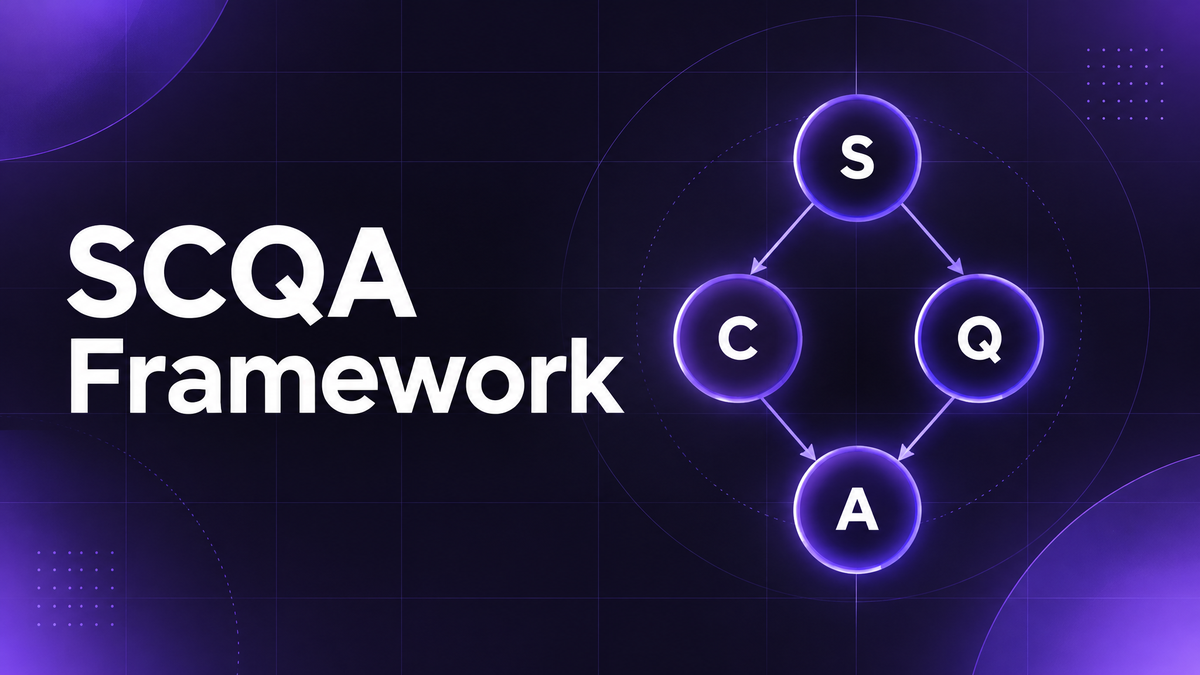
SCQA stands for Situation, Complication, Question, Answer. It was developed by Barbara Minto during her time at McKinsey & Company (1963–1973) as part of her broader Pyramid Principle — a structured communication method for presenting complex recommendations to senior executives.
The original model was designed for management consulting documents and presentations. But its underlying logic maps perfectly onto direct-response copywriting, particularly for considered purchases where the buyer needs to understand why before they'll act.
Here's how each element works:
- Situation: Establish shared context — a fact or circumstance the reader already accepts as true. This creates common ground and signals that you understand their world.
- Complication: Introduce the tension — a change, obstacle, or problem that disrupts the situation and creates urgency. This is the "but" in the story.
- Question: Articulate the decision the complication forces. This is often implicit in consumer copy but explicit in B2B: "So how do we solve this without rebuilding from scratch?"
- Answer: Deliver your recommendation — the product, service, or approach that resolves the complication. In direct-response copy, this is where your offer lives.
Unlike PAS, which agitates the problem to create emotional pressure, SCQA builds a logical case. Unlike AIDA, which starts with attention-grabbing hooks, SCQA starts with agreement — a far more powerful opening when your reader is skeptical, time-poor, or analytically minded.
SCQA vs. AIDA vs. PAS: Which Framework Wins?
The honest answer: none of them wins universally. Each framework is a scaffold, not a guarantee. But understanding where each excels helps you choose the right tool for the job.
| Framework | Best For | Buyer Awareness Level | Emotional vs. Rational | Typical Use Case |
|---|---|---|---|---|
| SCQA | High-consideration B2B offers | Problem-aware to solution-aware | Rational-first | SaaS landing pages, proposals, executive emails |
| AIDA | Broad consumer and B2B acquisition | Unaware to solution-aware | Balanced | Display ads, email sequences, sales pages |
| PAS | Problem-aware audiences needing urgency | Problem-aware | Emotional-first | Short-form ads, email subject lines, VSLs |
The key insight: SCQA doesn't replace AIDA or PAS. It fills a gap they leave open — the rational, high-stakes decision where emotional pressure feels manipulative and the buyer needs a clear logical path to "yes."
When SCQA Outperforms PAS
PAS works by intensifying pain. That's effective when your buyer is already frustrated and looking for relief. But when your buyer is a senior executive evaluating a strategic investment, agitation can backfire — it signals that you're selling, not advising.
SCQA positions you as a trusted advisor. You're not poking at wounds; you're demonstrating that you understand the business context and have a reasoned recommendation. That's a fundamentally different relationship — and it's the one that closes enterprise deals.
When SCQA Outperforms AIDA
AIDA's "Attention" hook often relies on pattern interrupts, bold claims, or curiosity gaps. These work brilliantly for cold traffic. But a CFO who receives 200 emails a day has developed immunity to attention-grabbing subject lines. What cuts through for them is immediate relevance — a message that opens with something they already know to be true about their situation.
SCQA's Situation element does exactly that. It earns attention through recognition, not novelty.
The Four Elements of SCQA in Depth
1. Situation: Start With What They Already Know
The Situation is not your hook. It's not a bold claim or a surprising statistic. It's a statement of shared reality — something your reader would nod at if you said it in a meeting.
Good Situation statements are:
- Factual and verifiable
- Specific to the reader's context
- Brief — one to three sentences maximum
- Free of your product or brand
Example (SaaS finance tool): "Finance teams at mid-market SaaS companies typically close their books within five to seven business days each month."
Example (marketing agency): "Most e-commerce brands running paid social allocate 70–80% of their ad budget to acquisition campaigns."
Notice what's absent: no claim about your product, no problem statement yet, no urgency. Just a fact the reader accepts. This creates the psychological foundation for everything that follows.
2. Complication: Introduce the Tension
The Complication is the "but." It's the change, constraint, or obstacle that makes the Situation insufficient. This is where you introduce the problem — but unlike PAS, you don't agitate it. You state it clearly and let the reader's own understanding of the stakes do the work.
Effective Complications are:
- A direct consequence of the Situation
- Specific and credible, not vague or exaggerated
- Something the reader recognizes from their own experience
- Framed as a business problem, not a personal failure
Example (SaaS finance tool): "But as subscription models grow more complex — with usage-based pricing, mid-cycle upgrades, and multi-currency contracts — manual reconciliation is adding two to three extra days to that close cycle and introducing errors that require audit remediation."
Example (marketing agency): "But with iOS privacy changes and rising CPMs, acquisition-only strategies are delivering diminishing returns — and most brands have no systematic approach to monetizing the customers they've already paid to acquire."
The Complication creates urgency without manipulation. The reader feels the tension because it's real, not because you've artificially amplified it.
3. Question: Make the Decision Explicit
In most copywriting frameworks, the question is implicit. SCQA makes it explicit — and this is one of its most powerful features for B2B copy.
The Question articulates the decision the Complication forces. It's the "so what do we do about it?" moment. In a sales context, it also pre-frames your answer as the logical response to a genuine business need rather than a vendor pitch.
Example (SaaS finance tool): "How can finance teams close faster and more accurately without replacing their existing billing infrastructure?"
Example (marketing agency): "How do you build a retention revenue engine that works alongside your acquisition campaigns — without adding headcount or rebuilding your tech stack?"
The Question can be stated explicitly (as a question) or implied through a transitional phrase like "The challenge is finding a way to..." or "What's needed is a solution that..." In shorter copy, you may omit it entirely and move directly from Complication to Answer — but in longer-form content like proposals or landing pages, making it explicit strengthens the logical flow.
4. Answer: Deliver the Recommendation
The Answer is your offer — but framed as a recommendation, not a pitch. This distinction matters enormously in B2B copy. A pitch says "buy our product." A recommendation says "here's what the evidence suggests you should do, and here's why our approach delivers it."
Strong Answers in SCQA copy:
- Lead with the outcome, not the mechanism
- Connect directly to the Complication
- Include proof — case studies, data, testimonials — to substantiate the claim
- End with a clear, low-friction call to action
Example (SaaS finance tool): "Automated reconciliation software that connects to your existing billing system can reduce close time by 40% and eliminate manual adjustment errors — without a system migration. [Company] customers at comparable scale have reduced their close cycle from seven days to four within the first quarter."
Example (marketing agency): "A retention-first email and SMS program, built on your existing customer data, can generate 25–35% of total revenue from customers you've already acquired. We've built this for eleven e-commerce brands in the past 18 months, with an average 4.2x return on retainer within six months."
SCQA in Practice: Five Real-World Applications
1. B2B SaaS Landing Page
SCQA is particularly powerful for SaaS landing pages targeting decision-makers rather than end users. The structure maps naturally onto the above-the-fold section:
Situation: "Revenue operations teams at Series B and C SaaS companies manage an average of four to six disconnected data sources across CRM, billing, and analytics."
Complication: "When those sources fall out of sync — which happens after every pricing change, product update, or sales territory shift — forecasting accuracy drops and pipeline reviews become exercises in reconciling spreadsheets rather than making decisions."
Question: "How do you get a single, reliable revenue view without a six-month data engineering project?"
Answer: "[Product] connects your existing stack in 48 hours and gives your RevOps team a live revenue model that updates automatically. No custom code. No data warehouse required."
2. Executive Cold Email
Cold email is where SCQA's "start with what they know" principle pays the biggest dividends. Most cold emails open with a compliment or a bold claim. SCQA opens with a fact — and that immediately signals that you've done your research.
Subject: Finance close cycles at [Company size] SaaS companies
Situation: "Most finance teams at your stage are closing books in five to seven days."
Complication: "With usage-based pricing now live, that window is likely stretching — and the manual adjustments are creating audit risk."
Answer: "We've helped three companies at your stage cut close time by 40% without touching their billing system. Worth a 20-minute call to see if the same approach applies?"
Note: the Question is implied rather than stated. In short-form copy, this is often the right call — the Answer follows naturally from the Complication without needing an explicit bridge.
3. Agency Proposal Opening
Proposals are where SCQA was born. Use it to open your executive summary and you immediately demonstrate strategic thinking rather than vendor positioning.
Situation: "[Client] has grown paid acquisition revenue by 34% year-over-year, with a current blended CAC of $87 across Meta and Google."
Complication: "However, 68% of acquired customers make only one purchase, and the LTV:CAC ratio of 1.8x is below the 3x threshold typically required for sustainable paid growth at this scale."
Question: "How does [Client] improve LTV without reducing acquisition investment or adding significant operational overhead?"
Answer: "A structured post-purchase email and SMS program, built on [Client]'s existing Klaviyo account and customer data, can realistically move the LTV:CAC ratio to 2.8–3.2x within 12 months. This proposal outlines the specific approach, timeline, and investment required."
4. LinkedIn Thought Leadership Post
SCQA works exceptionally well for LinkedIn content targeting B2B buyers. The structure creates a natural narrative arc that keeps readers engaged through the full post.
Situation: "Most SaaS companies spend 80% of their marketing budget on acquisition."
Complication: "But with average trial-to-paid conversion rates sitting at 15–20%, that means 80% of acquired trials never become customers — and most companies have no systematic plan for the ones who don't convert immediately."
Question: "What if the highest-ROI campaign you could run isn't a new acquisition channel — it's a re-engagement sequence for the trials you already paid to acquire?"
Answer: "Here's the three-email sequence we use to recover 12–18% of expired trials within 30 days..."
5. Webinar Registration Page
Webinar registration pages often struggle because they lead with the format ("Join our webinar") rather than the value. SCQA fixes this by leading with the business problem the webinar solves.
Situation: "E-commerce brands running paid social are seeing CPMs increase 40–60% year-over-year."
Complication: "At the same time, third-party audience targeting has become less reliable, making it harder to reach new customers efficiently — and most brands are still running the same acquisition-only playbook they used in 2021."
Answer: "In this 60-minute session, we'll show you the retention-first paid social strategy that three 8-figure brands used to maintain profitable growth despite rising acquisition costs. Register below."
Common SCQA Mistakes and How to Fix Them
Mistake 1: Making the Situation Too Long
The Situation should be one to three sentences. If you're writing four or five sentences of context before introducing the Complication, you've lost your reader. The Situation earns attention through recognition, not through comprehensiveness. State the shared reality and move on.
Mistake 2: Agitating the Complication Like PAS
SCQA's Complication is not PAS's Agitation. Don't pile on emotional language, worst-case scenarios, or fear-based framing. State the business problem clearly and specifically. The reader's own understanding of the stakes will do the rest — you don't need to amplify it artificially.
Mistake 3: Skipping the Question
In longer-form copy — landing pages, proposals, sales decks — the Question is doing important work. It pre-frames your Answer as the logical response to a genuine need rather than a vendor pitch. Skipping it makes the transition from Complication to Answer feel abrupt and salesy. Include it, even if it's just one sentence.
Mistake 4: Leading the Answer With Features
The Answer should lead with the outcome, not the mechanism. "Our platform uses AI-powered reconciliation algorithms" is a feature. "Finance teams using our platform close their books in four days instead of seven" is an outcome. Lead with the outcome, then explain the mechanism if the reader needs it to believe the claim.
Mistake 5: Using SCQA for Impulse Purchases
SCQA is a rational framework. It works when the buyer needs to understand and agree before they act. For impulse purchases, low-ticket consumer products, or audiences who are already emotionally primed to buy, PAS or AIDA will typically outperform it. Match the framework to the buyer's decision-making process, not to your preference.
How to Combine SCQA With Other Frameworks
SCQA doesn't have to stand alone. Some of the most effective B2B copy combines SCQA's logical structure with elements from other frameworks:
- SCQA + Inverted Pyramid: Use SCQA for the overall structure, then apply Inverted Pyramid principles within each section — lead with the most important information, follow with supporting detail. This is particularly effective for mobile landing pages where readers may not scroll.
- SCQA + FAB: Use SCQA to establish the business case, then use Features-Advantages-Benefits to detail how your product delivers the Answer. This works well in the lower sections of a landing page after the above-the-fold SCQA hook.
- SCQA + Social Proof: Insert case studies and testimonials between the Answer and the CTA. The SCQA structure establishes why the reader should care; the social proof establishes that your Answer actually works.
Implementing SCQA in Your Copy: A Step-by-Step Process
Before you write a single word of SCQA copy, answer these four questions:
- What does my reader already know and accept as true about their situation? (This becomes your Situation.)
- What specific change, constraint, or problem is making that situation insufficient? (This becomes your Complication.)
- What decision does that problem force? (This becomes your Question.)
- What outcome does my product or service deliver, and what evidence supports that claim? (This becomes your Answer.)
If you can't answer all four questions specifically and credibly, you're not ready to write. The research and customer discovery that goes into answering these questions is what makes SCQA copy feel authoritative rather than generic.
Once you have your answers, write a rough draft of each element in one to three sentences. Then expand the Answer section with proof — case studies, data, testimonials — and a clear call to action. Review the full piece to ensure each element flows logically into the next: Situation → Complication → Question → Answer should feel like an inevitable progression, not a series of disconnected paragraphs.
Start Using SCQA in Your Next B2B Campaign
The SCQA framework won't replace AIDA or PAS in your toolkit — but it fills a gap they leave open. When your buyer is a senior decision-maker, when the purchase is high-consideration, and when emotional pressure would undermine rather than accelerate the sale, SCQA gives you a structure that earns trust, demonstrates expertise, and moves the reader toward a decision through logic rather than manipulation.
Start small: rewrite the opening of your next cold email or landing page using SCQA. State a fact they already know. Introduce the complication that makes that fact insufficient. Ask the question it forces. Deliver your recommendation with evidence. Then test it against your current control.
If you're building advertorials, sales pages, or email sequences and want a framework that adapts to every buyer type — from impulse consumer to analytical executive — Advertorial Wizard gives you the tools to apply SCQA and a dozen other proven frameworks to your copy, with AI-assisted generation and real-time optimization built in.
You've read the part most people skip.
Get the 3 frameworks that make this land in your inbox - every Thursday. One email a week. Unsubscribe in one click.
Enjoyed this article?
Try Advertorial Wizard to create high-converting copy.