
PAS Copywriting: How Problem-Agitate-Solution Drove $1M Launches
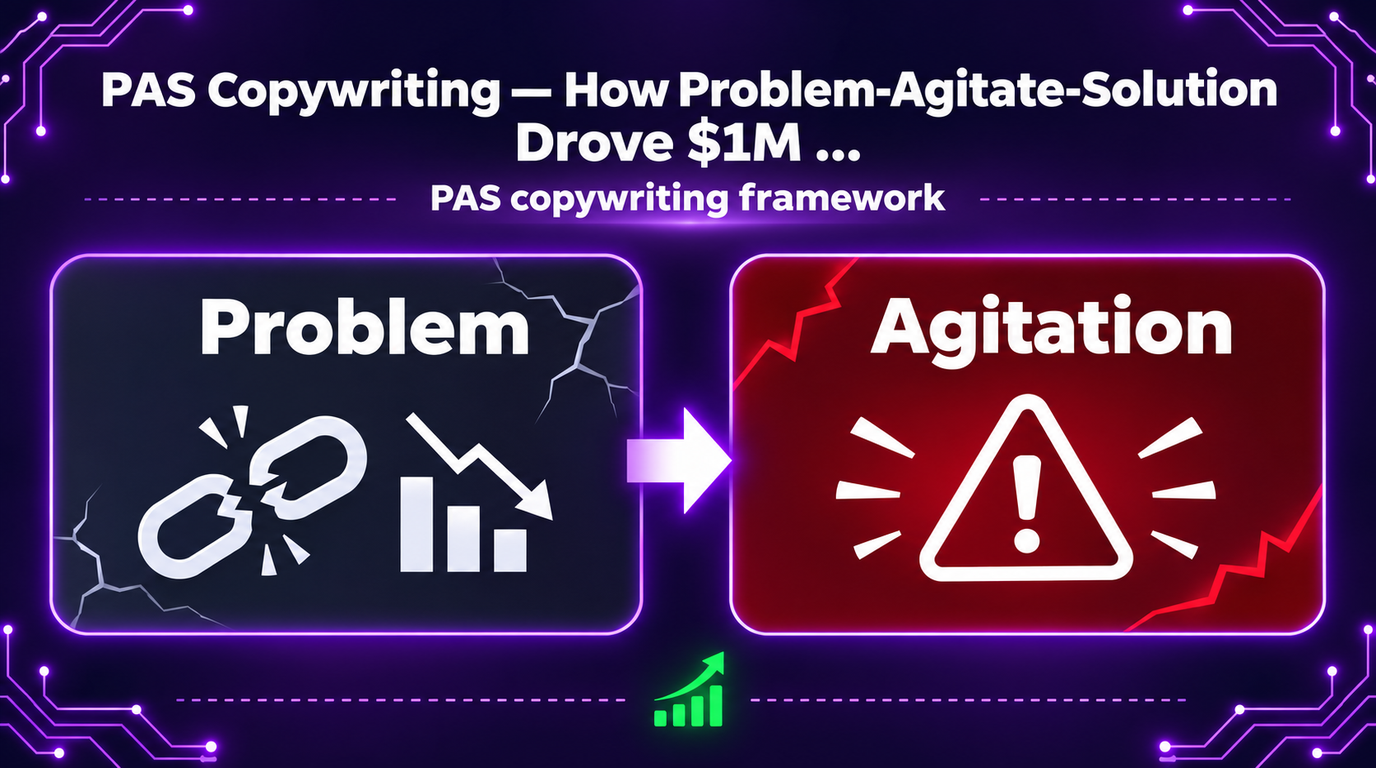
A launch email does not need more words. It needs the right pressure, in the right order.
1. What the PAS copywriting framework actually does
The PAS copywriting framework gives you three jobs: name the problem, stir the discomfort that follows it, then present the solution as a way out. That sequence sounds obvious. Most email copy still fails because writers treat agitation like a louder insult or a pile of vague complaints.
Gary Halbert would call that weak salesmanship. A problem becomes painful when it interrupts something the reader already wants. A solution becomes compelling when it restores that thing. The framework works when the reader moves through a logical chain:
- Problem: “Your product launches stall before paid ads begin.”
- Agitate: “Every wasted week delays validation, burns runway, and leaves a competent team guessing.”
- Solution: “LaunchMap turns your existing launch plan into a sequence of testable offers.”
Notice the movement. The first sentence identifies a condition. The second shows its consequences. The third offers a specific change. Nothing is shouted. Nothing is exaggerated. The tension does the selling.
That is why the PAS copywriting framework remains useful for email, landing pages, ads, and sales pages. It does not prescribe one rigid set of sentences. It gives you a persuasive order of thought.
For a broader look at how attention, interest, desire, and action fit together, see why the AIDA framework still dominates.
2. Stage one: diagnose the problem before writing a word
Do not begin with a feature list. Begin with the moment your reader recognizes.
Imagine you sell a launch-planning tool to small software teams. “All-in-one platform” tells the reader nothing. “Your launch plan lives in six documents” tells them you have seen their desk. Better still: “Your launch plan is scattered across a spreadsheet, a deck, three message drafts, and somebody’s notebook.”
Halbert was a practical man. He would want the copy grounded in the actual behavior of the market, not in what the product team wishes buyers were doing. You need language that fits the customer’s private vocabulary.
Research customer calls. Note the phrases repeated by people who have money to solve the problem. Read support tickets. Watch sales objections. Collect the words buyers use before and after they buy.
Then isolate three layers of the problem:
- The visible task: “We cannot get the launch sequence organized.”
- The hidden cost: “The team keeps revisiting decisions instead of testing demand.”
- The deeper fear: “We might launch something nobody wants.”
A strong Problem section can touch any of these layers. It must create recognition without blaming the reader. “You are wasting money” is clumsy. “You are paying to relearn the same launch lesson every quarter” is sharp because it names a pattern and its price.
Write the problem in the reader’s terms. If your product is a bookkeeping service, do not call it “financial optimization infrastructure.” If it is a meal-planning service, do not call it “nutritional lifecycle management.” Clarity beats internal sophistication.
3. Stage two: agitate the consequences, not the reader
Agitation is the engine of the PAS copywriting framework. It connects today’s annoyance to tomorrow’s regret. If you skip it, the solution looks optional. If you overdo it, the copy sounds theatrical.
Compare two versions:
Weak: “Launching without a plan is terrible. It can be stressful and lead to failure.”
Strong: “Without one approved launch sequence, every team meeting becomes another debate. The deadline moves. The message changes. The launch date remains.”
The second version agitates because every sentence reveals another consequence. It also creates rhythm. Short sentences can tighten the pressure:
The brief changes. The timeline slips. The launch stays in sight but never arrives.
Halbert favored concrete sensory detail over generic urgency. “Your launch is stuck” is a conclusion. “The product is ready, the email is open, and nobody can agree on the offer” is a scene. Show the reader inside the stalled moment.
You can agitate through several mechanisms:
- Time: “Each week without a validated offer adds another week of delay.”
- Money: “The team spends another month building features the market has not requested.”
- Effort: “The founder rebuilds the same pitch while the deadline quietly passes.”
- Reputation: “Buyers begin to wonder whether the next release will arrive on time.”
- Opportunity: “A window closes while the team optimizes a page nobody sees.”
Choose the mechanism that matters most to your buyer. Do not list all five. Useful agitation selects one costly truth and examines it.
4. Stage three: make the solution feel mechanical
The solution should not appear because the copy needs a resolution. It should appear because it answers the exact problem you described.
A weak transition sounds like this:
“Don’t worry! There is a powerful solution that can help you overcome these challenges. Our revolutionary platform is designed to transform your workflow.”
Now compare a direct solution:
“LaunchMap puts the problem, offer, proof, and launch tasks on one page. You choose a target customer, draft the offer, and assign the next test. The team sees what is ready and what is still blocking release.”
The second version earns its place. It mirrors the stalled launch. It explains the mechanism. The reader can picture using it.
Gary Halbert would not ask the product to rescue every business problem. He would make one promise and make it visible. “Transform your workflow” asks the reader to infer the value. “Choose a customer, draft the offer, and assign the next test” shows it.
This is where your product demonstration matters. You do not need every feature. You need the three steps that turn the promised outcome into a believable action. For comparison, our guide to the FAB copywriting framework explains how to move from a feature to a customer benefit.
5. A complete PAS email, annotated
Here is a compact launch email built around the framework. The subject line promises a specific result. The opening names the recognizable problem. The middle exposes the consequences. The solution then answers them.
Subject: Your next launch needs one approved sequence
Problem:
Your product is ready, but the launch is still spread across a spreadsheet, a deck, and three versions of the announcement.
Agitate:
So the team meets again. Someone changes the headline. Someone else rebuilds the email. The launch date moves because nobody can prove the offer is ready. Then the quarter ends, and the work becomes an expensive lesson nobody planned to buy.
Solution:
LaunchMap turns the plan into one sequence: target customer, core offer, proof, and launch task. Each piece gets an owner. Each unfinished step blocks the next one. Everyone can see what is ready and what needs attention before you send the email.
Proof:
One early-access team replaced four planning documents with a single map and released in nine days. Another used the offer test to revise its message before committing its ad budget.
Action:
Build your first launch map today. Choose one product, name one buyer, and put the next three steps on one page. Start your first map.
The logic runs from familiar frustration to visible relief. The action follows the promise. It does not ask for an enormous commitment before the reader has seen how the product works.
6. How the framework created a path to a $1M launch
No framework prints money. A strong PAS structure does something more useful: it helps a market understand a difficult offer quickly enough to act.
Consider a subscription service for financial teams. The market already knows spreadsheets are common. It does not automatically see wasted review cycles as a serious problem worth paying to solve. The launch email therefore did not begin with “AI-powered financial workflow automation.” It began with the operating frustration:
“Your finance team spends Monday reconciling numbers that should have matched yesterday.”
Then it followed the consequences through the week:
“Reports wait for review. Leaders make calls with stale numbers. By Friday, the team is chasing the same exceptions instead of answering new questions.”
The product entered only after that consequence was clear:
“LedgerLoop connects the source data, flags the exceptions, and prepares the weekly report for review. Your team starts with the mismatches, not another dashboard.”
That message did not guarantee a $1M launch. The launch team still needed a credible offer, evidence, distribution, and a strong sales process. But PAS gave the email a job: it converted an abstract category into a felt operational problem.
To reach $1M in annual recurring revenue, many teams also use a more aggressive offer. PAS can support that approach when the message first earns attention. Learn how in our comparison of the main copywriting frameworks.
7. Where writers weaken the bridge
The bridge from agitation to solution is where PAS emails often fail. Writers name a dramatic problem, then introduce an unrelated product. The reader feels manipulated because no logical connection appears.
Use this test: remove the product name. Does the solution still read like the clearest response to the stated problem? If not, rewrite the copy.
| Weak choice | Stronger choice | Why it works |
|---|---|---|
| “Our platform solves your business problems.” | “The map shows which offer test blocks your launch.” | It repeats the mechanism in the customer’s language. |
| “Say goodbye to inbox chaos.” | “Route every reply to one owner and close it with a next step.” | It demonstrates the change instead of announcing a benefit. |
| “Unlock your potential.” | “Find the three messages that buyers answer within ten seconds.” | It makes the desired result specific. |
Three habits make the bridge sturdier:
- Mirror the problem: Use nouns and verbs from the agitation in the solution.
- Show the mechanism: Explain the process that produces the outcome.
- Lower the risk: Explain what the buyer does next and how simple it is.
Do not promise “freedom from complexity.” Tell the reader how the complexity gets handled. Plain language is not a lack of ambition. It is respect for the buyer’s time.
8. Adapt PAS without turning it into a template
The PAS copywriting framework is flexible, but flexibility requires judgment. A cold email to a busy executive, a consumer launch, and a high-ticket sales page will need different pressure and different proof.
For a cold email, begin with the problem specific enough that the recipient recognizes it. Keep agitation compact. Use one consequence, not four. Show the mechanism in one sentence, then invite a reply.
Cold email example:
“Your launch plan is ready, but your best message is still buried in a draft? Every extra revision weakens the test. Briefcase maps the offer, proof, and next action so your team can test it this week. Want the template?”
For a long-form sales page, you have room to deepen the consequences. You can show the cost of inaction, explain why common workarounds fail, and build proof around each stage.
For an existing-customer email, do not manufacture a crisis the customer already feels. Agitate around the next unresolved problem: unused seats, an incomplete setup, or a missed outcome. The solution should help the customer capture more value.
Halbert’s lesson is not “write short.” It is “write the thought the reader needs next.” A formula can organize your thinking. It cannot substitute for judgment.
9. Test the sequence, not just the sentence
Copywriters love to debate individual lines. Strong launch copy also needs structural testing.
Run at least two versions with different Problem angles. Keep the offer, proof, and action unchanged. If Version A identifies the right pain more clearly, it should improve the click-through rate. Then test the agitation: one version shows the operational consequence, while another shows the cost to the team.
Next, test the solution mechanism. The “organization” version may be less effective than “see what blocks launch.” Feature language can sound interchangeable; mechanism language shows a specific job.
Finally, test the action. A lower-commitment request can produce more replies from a smaller audience. A direct trial request may produce fewer replies but better intent. Judge each version against the behavior that matters.
- Open rate: Did the subject line earn attention?
- Click rate: Did the problem create relevance?
- Reply rate: Did the mechanism create interest?
- Conversion rate: Did the proof and offer answer the remaining doubt?
- Revenue per recipient: Did the launch create enough value to justify the sales effort?
Do not declare failure because one metric dipped while revenue rose. The PAS copywriting framework creates a sequence of decisions. Measure the whole sequence, then locate the weak link.
10. The final checklist before you send
Read the copy aloud. If it feels like a collection of marketing claims, it probably lacks specificity. If it feels like a clear account of a costly problem followed by a believable way out, the structure is working.
Before publishing, ask:
- Can the reader recognize the problem in the first two sentences?
- Does the agitation reveal a real consequence rather than insult the reader?
- Is the consequence specific enough to imagine?
- Does the solution directly answer that consequence?
- Can you explain the mechanism in one clear sentence?
- Does the proof make the promise believable?
- Is the next action obvious and proportionate to the reader’s uncertainty?
- Have you removed every sentence that adds excitement but no clarity?
That final question matters. PAS supplies pressure, but unearned pressure damages trust. Show what happened, what it costs, and what changes. Let the reader complete the conclusion.
The best PAS copywriting framework application does not feel like a trick. It feels like recognition followed by relief. The writer names the difficulty accurately. The agitation gives the difficulty its proper weight. The solution then becomes the most sensible next move.
You've read the part most people skip.
Get the 3 frameworks that make this land in your inbox - every Thursday. One email a week. Unsubscribe in one click.
Enjoyed this article?
Try Advertorial Wizard to create high-converting copy.