
How to Write Advertorial Copy That Moves Cold Traffic to the Product Page
How to Write Advertorial Copy That Moves Cold Traffic to the Product Page
Most cold traffic dies at the ad. The click happens, the pre-lander loads, and within eight seconds the visitor is gone — not because the product is wrong, but because the copy tried to sell before it earned the right to be heard.
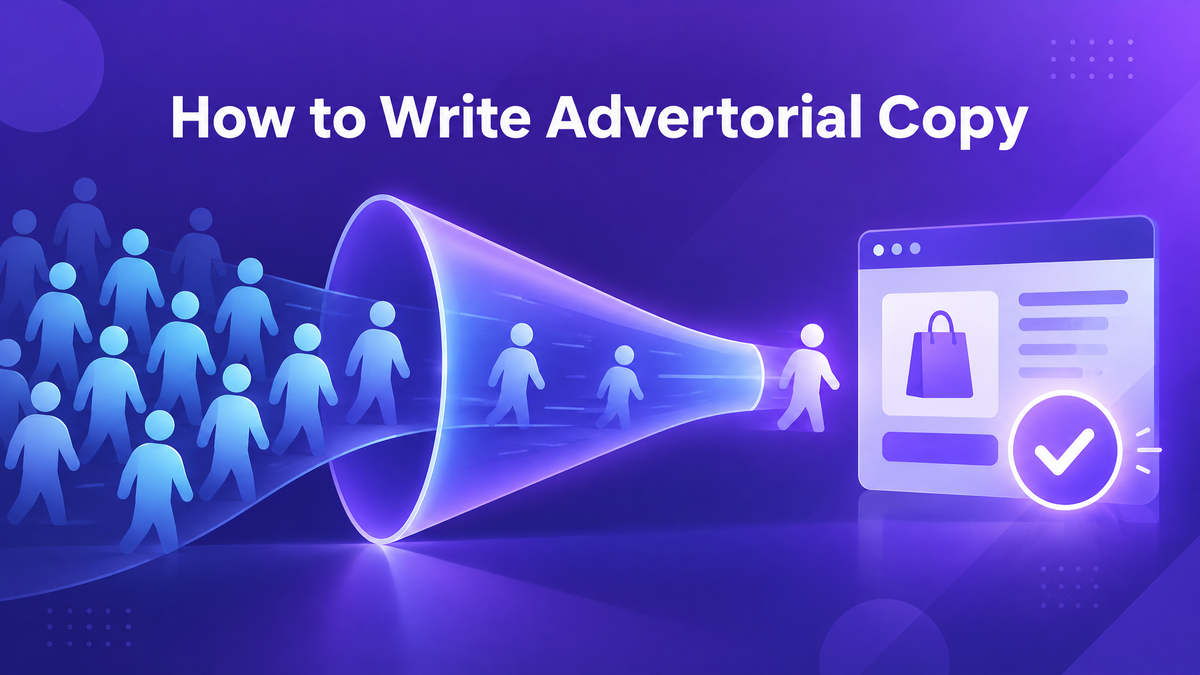
Advertorials fix this. A well-constructed advertorial meets unaware or problem-aware readers where they are, walks them through a single governing idea, and hands them to the product page already convinced of the mechanism. The product page then closes what the advertorial opened.
This guide gives you a six-beat advertorial workflow — from cold-traffic diagnosis to final continuity audit — so you can move readers from "I've never heard of this" to "I need to see the offer" without a hard sell.
Why Cold Traffic Needs a Different Kind of Copy
Warm traffic — people who already know your brand, have read your emails, or searched for your product category — arrives with context. They know what you do. Cold traffic arrives with none of that. They clicked an ad because a headline or image interrupted their scroll. They have no loyalty, no trust, and no reason to stay.
Sending cold traffic directly to a product page is like proposing marriage on a first date. The product page assumes the reader already believes the mechanism works. Cold traffic doesn't believe anything yet.
An advertorial bridges that gap. It borrows the format of editorial content — an article, a story, a reported piece — to introduce the problem, explain the mechanism, and build belief before the reader ever sees a price.
The Awareness Spectrum
Eugene Schwartz described five levels of buyer awareness in Breakthrough Advertising. Cold traffic typically sits at the bottom two:
| Awareness Level | What the Reader Knows | Copy Entry Point |
|---|---|---|
| Unaware | Doesn't know they have the problem | Story, pattern interrupt, curiosity hook |
| Problem-Aware | Knows the problem, not the solution | Problem identification, agitation, mechanism reveal |
| Solution-Aware | Knows solutions exist, not your product | Mechanism differentiation, proof |
| Product-Aware | Knows your product, not convinced | Objection handling, social proof, urgency |
| Most Aware | Ready to buy, needs the offer | Direct offer, price, CTA |
Your advertorial's job is to move a reader from Unaware or Problem-Aware to Solution-Aware or Product-Aware. The product page handles the rest.
The Six-Beat Advertorial Framework
Every high-converting advertorial follows a recognizable architecture. The beats can be compressed or expanded depending on the product's complexity and the reader's starting awareness level, but the sequence rarely changes.
Beat 1: The Hook (Interrupt and Earn Attention)
The hook is the first sentence, headline, or opening image. Its only job is to stop the scroll and earn the next line. Cold traffic will not give you a second chance.
Effective hooks for cold traffic fall into three categories:
- Curiosity gap: "The reason most email campaigns fail has nothing to do with your subject line."
- Counterintuitive claim: "Spending more on ads is making your conversion rate worse."
- Specific result: "This three-sentence email sequence generated $340,000 in seven days — without a single discount."
Notice that none of these hooks mention the product. They open a question the reader wants answered. The product is the answer — but the reader doesn't know that yet.
Beat 2: The Problem (Name What the Reader Already Feels)
After the hook, your reader is curious but skeptical. The fastest way to build trust with a stranger is to describe their problem more accurately than they can describe it themselves.
This is Voice of Customer research in action. Pull language from reviews, support tickets, forum posts, and customer interviews. Use their words, not yours.
A weak problem section sounds like this: "Many businesses struggle with low conversion rates."
A strong problem section sounds like this: "You've tested the headline. You've rewritten the CTA. You've added social proof, shortened the form, and moved the button above the fold. The conversion rate barely moved. And now your media buyer is asking why the cost per acquisition keeps climbing."
The second version names specific actions the reader has already taken. It demonstrates that you understand their world. That understanding is the foundation of trust.
Beat 3: The Mechanism (Explain Why the Problem Persists)
The mechanism is the reason the problem exists — and the reason existing solutions haven't fixed it. This is the intellectual core of your advertorial.
A strong mechanism does two things simultaneously: it explains why the reader's current approach isn't working, and it implies that your product has a different approach.
"The real problem isn't your headline. It's that your landing page is speaking to a buyer who already understands your category — but your ad is reaching people who've never heard of it. The page assumes belief the reader doesn't have yet."
This mechanism — the awareness mismatch — is specific, credible, and immediately actionable. It also sets up the product (an advertorial, a pre-lander, a bridge page) as the logical solution without naming it yet.
Beat 4: The Pivot (Introduce the Solution Category)
The pivot is the moment you shift from problem to possibility. You're not introducing the product yet — you're introducing the category of solution. This keeps the reader in discovery mode rather than sales-resistance mode.
Pivot language sounds like: "What the highest-converting funnels have in common isn't a better product page. It's a step before the product page — one that does the belief-building work so the page doesn't have to."
The pivot should feel like a natural conclusion the reader reaches themselves, not a claim you're making. Guide them to the insight; don't announce it.
Beat 5: Product and Proof (Show the Mechanism Working)
Now you can introduce the product — but frame it as an example of the mechanism, not as a sales pitch. Show it working. Use a case study, a before-and-after, a specific result with context.
Proof hierarchy for cold traffic (strongest to weakest):
- Specific results with named context ("A SaaS company selling a $297/month tool reduced cost per trial by 41% after adding a 600-word advertorial between their Facebook ad and their free-trial page.")
- Mechanism demonstration (show the advertorial, the email, the script — let the reader see it working)
- Third-party validation (industry data, expert quotes, published research)
- Testimonials with specifics (named, with results, not generic praise)
- Logic and reasoning (when data isn't available, a well-constructed argument)
Cold traffic is skeptical of testimonials and brand claims. Lead with mechanism demonstration and specific results. Save the testimonials for the product page, where the reader is already warmer.
Beat 6: The Offer Bridge (Hand the Reader to the Product Page)
The final beat is not a close — it's a handoff. You're not asking for a purchase. You're asking the reader to take the next step: visit the product page, watch the video, start the free trial.
The offer bridge should feel like a natural continuation of the story, not a gear shift into sales mode. The reader should feel like they're choosing to learn more, not being pushed toward a transaction.
Effective offer bridge language: "If you want to see the exact advertorial structure we use — including the six-beat template and a real example from a supplement brand that cut its cost per acquisition by 38% — the full breakdown is on the next page."
Notice: specific, curiosity-driven, and framed as more information rather than a purchase decision.
The Governing Idea: One Thread from Ad to Offer
The most common advertorial failure isn't weak copy — it's a broken thread. The ad makes one promise, the advertorial explores a different angle, and the product page talks about something else entirely. The reader arrives at each stage feeling slightly disoriented, and disorientation kills conversions.
Before you write a word of advertorial copy, define your governing idea: the single claim or insight that runs from the ad creative through the advertorial to the product page.
| Funnel Stage | Governing Idea Expression | Example |
|---|---|---|
| Ad headline | Hook version of the idea | "Why your landing page is losing buyers before they read a word" |
| Advertorial headline | Expanded version of the idea | "The Awareness Gap: Why Cold Traffic Dies on Landing Pages (And What to Put Before Them)" |
| Advertorial mechanism | Explanation of the idea | The awareness mismatch between ad audience and product page assumptions |
| Product page headline | Solution version of the idea | "The Pre-Lander System That Warms Cold Traffic Before It Hits Your Offer" |
| Product page proof | Evidence for the idea | Case studies showing CPL reduction after adding advertorial step |
When the governing idea is consistent, each stage of the funnel feels like a continuation of a conversation the reader is already having. Friction disappears. The reader moves forward because the next step answers the question the previous step raised.
Voice of Customer Research: The Foundation of Advertorial Copy
Advertorial copy that resonates with cold traffic is almost always built on customer language, not copywriter language. The difference is the difference between a reader thinking "this person gets it" and "this sounds like an ad."
Where to Find Cold Traffic Language
- Amazon reviews for products in your category (especially 3-star reviews, which describe both what worked and what didn't)
- Reddit threads in relevant subreddits (search for the problem your product solves)
- YouTube comments on videos about the problem or solution category
- Trustpilot and G2 reviews for competitors
- Support tickets and sales call transcripts from your own customers
- Facebook Groups where your target audience discusses their challenges
What to Extract
You're looking for four things:
- Problem language: How do they describe the frustration? What words do they use?
- Failed solutions: What have they already tried that didn't work?
- Desired outcome: What does success look like to them? How do they describe it?
- Objections: What makes them skeptical? What would they need to believe before buying?
Build a claim inventory from this research: a list of specific, customer-sourced statements about the problem, the mechanism, and the desired outcome. Your advertorial copy should draw from this inventory rather than from your own assumptions about what the reader cares about.
Common Advertorial Mistakes That Kill Cold Traffic Conversions
Mistake 1: Selling Too Early
The most common advertorial failure is introducing the product before the reader believes the mechanism. If the reader hasn't accepted that the problem is real and that existing solutions don't fix it, they'll treat any product mention as a sales pitch — and cold traffic is allergic to sales pitches.
Rule of thumb: the product should not appear until the reader has nodded along to at least two of the first three beats (hook, problem, mechanism).
Mistake 2: Generic Problem Framing
"Many businesses struggle with low conversion rates" is not a problem statement. It's a category description. Cold traffic readers don't see themselves in generic descriptions — they see themselves in specific ones.
Replace category descriptions with specific scenarios. Name the actions the reader has already taken. Describe the moment of frustration they've already experienced. The more specific the problem framing, the more the reader feels understood.
Mistake 3: Weak Mechanism
A mechanism that says "our product uses advanced technology to solve your problem" is not a mechanism — it's a claim. A real mechanism explains the causal chain: why the problem exists, why existing solutions don't fix it, and why your approach is different.
The mechanism is the intellectual heart of your advertorial. Spend more time here than anywhere else. A reader who understands and believes the mechanism is already 80% sold.
Mistake 4: Broken Continuity
If the ad promises one thing and the advertorial delivers another, the reader's first reaction is confusion — and confused readers don't convert. Run a continuity audit before publishing: read the ad, the advertorial, and the product page in sequence. Does each stage answer the question the previous stage raised? Does the governing idea stay consistent throughout?
A Pre-Publication Checklist
Before sending cold traffic to your advertorial, run through this checklist:
- ☐ The hook creates a curiosity gap or names a specific result without mentioning the product
- ☐ The problem section uses customer language from Voice of Customer research
- ☐ The mechanism explains why the problem persists and why existing solutions fail
- ☐ The pivot introduces the solution category without naming the product
- ☐ The proof section leads with specific results or mechanism demonstration, not testimonials
- ☐ The offer bridge asks for the next step, not a purchase decision
- ☐ The governing idea is consistent from ad headline to product page headline
- ☐ No section assumes knowledge the cold traffic reader doesn't have
- ☐ The advertorial reads like editorial content, not a sales page
- ☐ The CTA on the offer bridge matches the first CTA on the product page
Putting It Together: A Real-World Example Structure
Here's how the six-beat framework looks applied to a SaaS product that helps e-commerce brands reduce cart abandonment:
Ad headline (hook): "The reason 73% of shoppers abandon their cart has nothing to do with your checkout page."
Advertorial headline: "The Checkout Myth: Why Fixing Your Cart Page Won't Stop Shoppers From Leaving (And What Actually Will)"
Beat 1 — Hook: Opens with a specific scenario: a Shopify store owner who optimized every element of their checkout page and still saw 71% abandonment.
Beat 2 — Problem: Describes the frustration of running A/B tests on checkout copy, adding trust badges, simplifying the form — and watching the abandonment rate barely move.
Beat 3 — Mechanism: Explains that most cart abandonment happens because the shopper was never fully convinced before they added to cart. The checkout page is too late. The decision was already made — or unmade — on the product page.
Beat 4 — Pivot: Introduces the idea that the highest-converting stores focus on product page copy, not checkout optimization. The checkout is a symptom; the product page is the cause.
Beat 5 — Product and Proof: Shows a specific example: a brand that shifted its optimization focus from checkout to product page copy and reduced abandonment by 34% in 60 days. Includes the specific copy changes made.
Beat 6 — Offer Bridge: "If you want to see the exact product page copy framework they used — including the seven-section template and the three proof elements that made the biggest difference — the full case study is on the next page."
The reader arrives at the product page already believing the mechanism. The product page's job is now to show them the solution and make the offer. The advertorial did the heavy lifting.
Start With the Mechanism, Not the Headline
Most copywriters start with the headline. For advertorials targeting cold traffic, start with the mechanism instead.
Ask: what does the reader need to believe before they'll be interested in this product? What's the insight that, once understood, makes the product feel inevitable? Build the mechanism first. Then write the hook that opens the question the mechanism answers. Then write the problem section that makes the mechanism feel urgent. The headline comes last — it's a compression of the governing idea, not the starting point.
Cold traffic doesn't need a better headline. It needs a better argument. The six-beat advertorial framework gives you the structure to make that argument — one beat at a time, one belief at a time, until the reader arrives at your product page ready to say yes.
Ready to Write Advertorials That Convert Cold Traffic?
Advertorial Wizard gives you the frameworks, templates, and AI-assisted tools to build pre-lander copy that moves cold traffic through the awareness spectrum — from unaware to ready-to-buy — before they ever see your offer.
Whether you're running paid social, native ads, or display campaigns, the six-beat advertorial framework gives your funnel the bridge it needs between cold click and warm conversion.
Start building your advertorial today and see how a single well-constructed pre-lander can transform your cost per acquisition.
You've read the part most people skip.
Get the 3 frameworks that make this land in your inbox - every Thursday. One email a week. Unsubscribe in one click.
Enjoyed this article?
Try Advertorial Wizard to create high-converting copy.