
How To Write Advertorial Sales Pages That Convert Cold Clicks
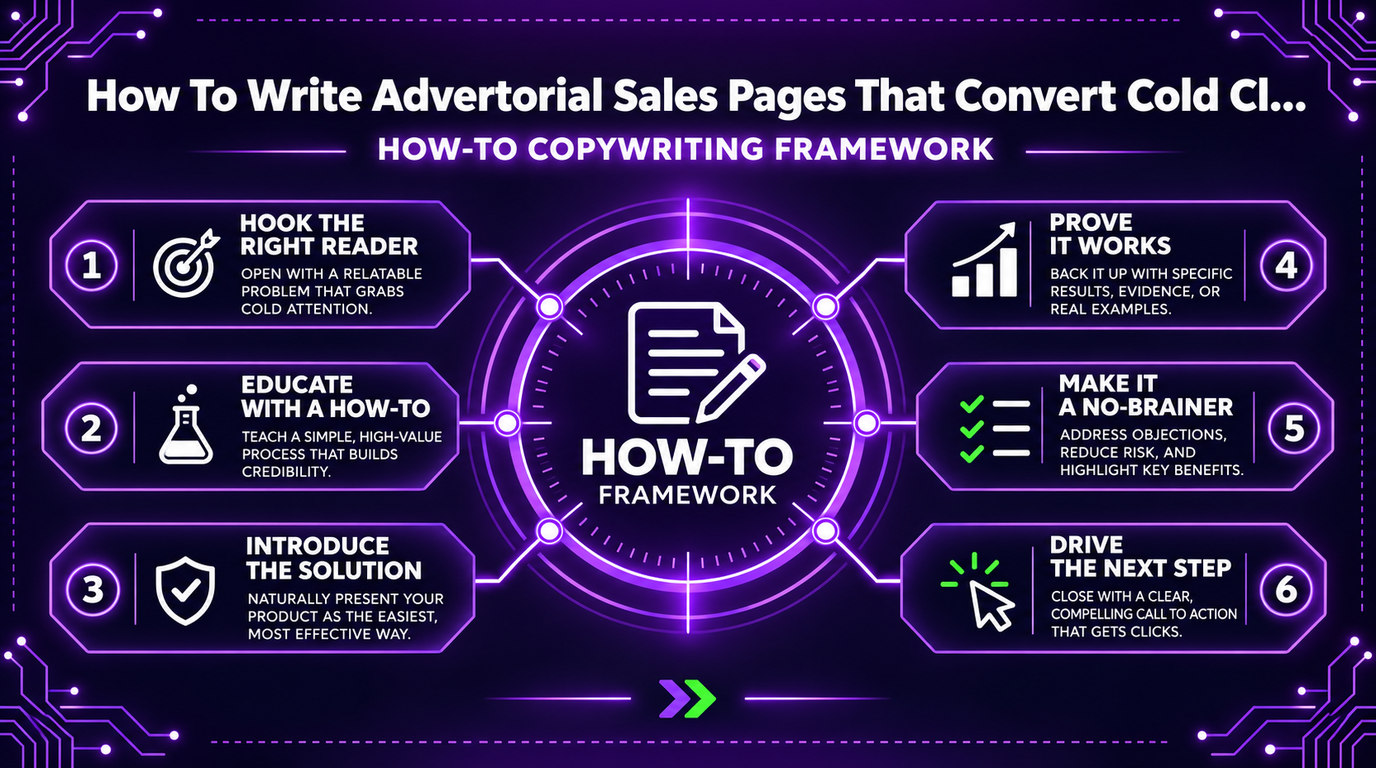
Cold readers do not care about your offer until they understand why the problem matters to them.
1. Start with the reader, not the product
A cold click is not a weak lead. It is a reader who has arrived without context. They may have seen your ad, clicked a search result, or landed on a page recommended by someone else. In every case, they do not yet know what you sell, how you help, or why they should keep reading.
That is why the best advertorial examples begin with a recognizable situation rather than a company introduction. They describe the reader's tension in language the reader already uses.
Compare these openings:
- Product-first: “Acme Software gives growing teams a smarter way to manage projects.”
- Reader-first: “Your team did not miss the deadline. It missed the shared picture of what needed to happen next.”
The second opening gives you material for a complete advertorial. It points toward a problem, creates curiosity, and invites the reader to continue. It also avoids the generic claim that a product “revolutionizes” a category.
David Ogilvy taught that useful information is the best way to sell. He was not arguing for dry facts. He was arguing for facts connected to a human need. If you are writing about accounting software, the fact may be automated receipts. The human need may be knowing which expenses require attention before tax season.
Use this sequence when you draft the opening:
- Name the situation the reader recognizes.
- Reveal the consequence they want to stop.
- Suggest that a better approach exists.
Do not explain your company history yet. Earn attention first, then establish relevance.
2. Build a promise the page can prove
An advertorial promise is not a slogan. It is a claim supported by everything that follows. If you promise to help readers cut reporting time, show the reporting workflow. If you promise to help them choose between products, show the criteria. If you promise a transformation, reveal the steps that produce it.
Strong advertorial examples often make the promise precise:
- “A five-minute setup for monthly client reports.”
- “A checklist for finding unused subscriptions before renewal.”
- “A simple way to compare three accounting workflows.”
Each promise tells the reader what they will learn and gives the rest of the page a job. That job is important because advertorials can easily drift from sales copy into a general guide. Guide readers will appreciate useful information, but they will not remember what your offer does.
Eugene Schwartz divided market sophistication into stages. A reader in the unaware stage needs the problem and the mechanism explained. A reader in the aware stage already knows the problem and wants a more precise solution. One promise cannot serve both groups equally well.
Before writing, answer three questions:
- What does the reader already know?
- What have they probably heard from competitors?
- What specific outcome can you credibly help them reach?
Then state the promise in plain language. Avoid abstract words such as “unlock,” “transform,” and “elevate” unless you immediately explain them in practical terms.
3. Teach before you pitch
The middle of an advertorial should deliver enough value to stand on its own. If the reader leaves before reaching the offer, you have failed twice: you lost the sale and wasted their time.
Useful teaching comes from a specific framework, process, or decision. Consider this advertorial example:
| Weak section | Useful section |
|---|---|
| Why project management matters | How to spot project risk before a deadline slips |
| Benefits of our platform | A three-step weekly project review |
| Features and specifications | How the platform supports each step |
This structure moves the reader from recognition to application. You establish expertise by teaching the method, then connect the product naturally.
Halbert's principle of “market first” applies here. Understand the market's existing beliefs before deciding what to say. Readers may not describe a task-management problem as “low project visibility.” They may say, “I always forget which client needs an update.” Teach in their vocabulary first.
To test whether the page teaches enough, read each section without seeing the product pitch. Ask: “Could a reader use this advice today?” If not, the section is probably an advertisement wearing educational clothing.
For a broader foundation, see how the AIDA framework still guides persuasive page structure.
4. Use an advertorial-to-sales transition
The transition should feel like the natural next step in the reader's decision, not an interruption. This is where many advertisers lose readers. The teaching ends with a sudden change in perspective: “Now, for the complete solution...”
A better transition points back to the promise and forward to the mechanism.
Weak transition:
“Now that you understand the challenges, why not consider our revolutionary platform?”
Stronger transition:
“A weekly review only works when every task, comment, and deadline stays in one view. That is the job [Product] handles: it keeps the review workflow together without asking your team to change how they already work.”
The stronger version names the requirement created by the teaching. It introduces the product as the answer to a problem the reader can now see.
This is the “bridge” in an advertorial. It connects the reader's problem to your mechanism and your offer. Gary Bencivenga's Before-After-Bridge lesson is especially useful: stack the proof before naming the product so the offer becomes a logical conclusion.
Use a four-part bridge:
- Before: Describe the current, costly situation.
- After: Show what the better situation looks like.
- Mechanism: Explain what makes the change possible.
- Offer: Present the product as the way to use that mechanism.
Keep product details in the bridge focused. You do not need every feature in the first sales paragraph. You need the feature that makes the promised outcome plausible.
5. Present proof in the order of doubt
Cold readers have doubts, but they rarely experience them in the order on your feature page. They may first ask, “Can this work for a small team?” Then they may ask, “Will people actually use it?” Finally, they may ask, “Is it worth paying for?”
Arrange proof around those questions. Testimonials can be excellent, but they become more persuasive when they answer the reader's immediate concern.
Suppose your product is an email scheduling tool. A testimonial from a customer with a large team does not help a solo consultant unless it addresses switching tools, saving time, or preventing missed follow-ups.
Useful proof includes:
- A customer example with enough context to be credible
- A before-and-after result
- A demonstration of the mechanism
- Independent validation, when available
- A clear explanation of what happens after purchase
Never invent a statistic, manufacture a testimonial, or stretch a customer result into a universal promise. Hopkins warned against claims that could not be tested. That discipline still matters: credibility is part of the offer.
Annotate the proof as you write it. Beside each item, note the doubt it resolves. If an element resolves no meaningful doubt, remove it. A long list of logos may look impressive, but it does little work for a reader who wants to know whether the product fits their situation.
6. Make the offer concrete
The offer is the part of the page where vague benefits become frustrating. Cold readers have followed your advice, seen your proof, and reached the question, “What exactly do I get?”
Describe the package in terms of the promise:
Weak offer: “Get access to our complete solution and start transforming your workflow today.”
Clearer offer: “Get a 14-day trial of [Product], including automated client reports, shared checklists, and weekly progress summaries. Connect your existing account in minutes, or cancel before the trial ends.”
The second version removes uncertainty. It tells the reader what they receive, how they begin, and what happens if the product is not right for them.
Include the commercial details that reduce friction:
- Price or a clear pricing explanation
- Trial, guarantee, or cancellation terms
- Setup requirements
- Who the offer is for
- The next step after clicking
Your pricing page can provide the full breakdown, but the advertorial should still remove obvious purchasing barriers. If price makes a narrow segment unsuitable, say so. Qualified readers respond better to an honest fit than to a promise that collapses at checkout.
7. Use one clear call to action
Advertorials often contain several calls to action: subscribe, download, compare, book a demo, and buy. A cold reader may understand each action individually while losing track of what you want them to do next.
Choose one primary action based on the reader's stage. If the page teaches a solution and presents a product, “Start your trial” is usually clearer than “Contact sales.” If the product requires a consultation and the article attracts high-value buyers, a booking step may be more appropriate.
Write the button label around the outcome or next step:
- “See Your Weekly Review”
- “Start a 14-Day Trial”
- “Get the Template”
- “Book a 15-Minute Walkthrough”
Avoid “Submit,” “Learn More,” and “Get Started” when you can describe the result more precisely. You are not trying to sound clever. You are helping the reader know exactly what happens next.
Repeat the same primary action at natural decision points, usually after the mechanism, after proof, and beside the offer. Do not interrupt every paragraph with the same command. The page should create a path, not a chorus.
To plan that path, review the PAS copywriting framework and how each stage changes the reader.
8. Edit for skimmers and doubters
Nobody reads a sales page in a straight line. Some arrive from a search result and scan headings. Others jump to proof, pricing, or the call to action. Strong advertorial examples are written for both deliberate readers and skimmers.
Use headings that make claims rather than label generic topics. “Why it works” tells the reader nothing. “Why a weekly review prevents missed dependencies” gives them a reason to continue.
Front-load useful information in each section. Put the conclusion in the first sentence, then support it. Bullets help when each point is distinct. Short paragraphs help when the thought requires emphasis. Tables help when readers are comparing options.
Now edit from the skeptic's perspective:
- Where could the reader become confused?
- Which claim lacks evidence?
- Which sentence sounds like company language?
- Where does the page ask for too much trust too soon?
- Does the offer match the promise?
Remove sentences that exist only to sound persuasive. They do not add proof, and they interrupt the reader's path.
Read the page aloud. If a sentence requires several attempts to understand, rewrite it. If two adjacent paragraphs make the same point, combine them. If a paragraph sounds like it belongs on every page about every product, delete it.
9. Learn from a repeatable advertorial template
A useful template does not lock you into one layout. It keeps the decision sequence intact while allowing you to adapt the content.
- Hook: Name the reader's recognizable problem.
- Promise: State what the page will help the reader understand or do.
- Context: Explain why the current approach falls short.
- Teaching: Provide a practical method, checklist, or comparison.
- Mechanism: Reveal the principle behind a better approach.
- Proof: Show outcomes, demonstrations, and customer evidence.
- Offer: Present the product and commercial terms clearly.
- Action: Give one clear next step.
This template resembles a how-to because it teaches readers how to achieve a result. The product enters as the tool that completes the method, not as the reason the article exists.
Choose one advertorial example in your category and annotate it. Mark the hook, promise, teaching block, bridge, proof, offer, and action. Then note why each section exists. Do this with two competitors as well. You will quickly see that the underlying structure matters more than the visual style.
Finally, map the page to your buyer's awareness. If the reader has never considered the problem, begin with recognition. If they already know the standard solution, move quickly to differentiation. If they are comparing brands, focus on fit and proof. The same template can serve each stage, but the emphasis must change.
10. Measure the page against one outcome
You cannot improve an advertorial by collecting every possible metric. Choose the action that represents meaningful progress, then inspect the path toward it.
For a direct-response page, measure sales or qualified trial starts. For a lead-generation advertorial, measure completed forms and sales-qualified leads. Track scroll depth and CTA clicks as diagnostic signals, not final proof of quality.
Compare several stages:
- Low scroll: The opening may not match the reader's problem.
- High proof engagement, low CTA clicks: The offer may feel disconnected or expensive.
- High CTA clicks, low conversion: The landing experience may introduce new friction.
- Strong conversion from a narrow segment: The page may be effective but underqualified.
Revise one element at a time. Replacing the hook can change traffic quality. Shortening the offer can change conversion. Adding proof can change objection rates. Otherwise, you cannot tell which change caused the result.
The best advertorial examples are not accidental collections of persuasive phrases. They follow a sound decision path: recognize the problem, promise a useful outcome, teach the method, reveal the mechanism, answer doubt, present a clear offer, and make the next step obvious.
If you want feedback on structure before publication, review your draft against the Advertorial Wizard pricing and project options. Then apply these advertorial examples as a practical standard for every cold-click page you publish.
You've read the part most people skip.
Get the 3 frameworks that make this land in your inbox - every Thursday. One email a week. Unsubscribe in one click.
Enjoyed this article?
Try Advertorial Wizard to create high-converting copy.